
1. Definition and Classification of Food
Module 1 · Introduction to Human Food, Nutrition & Physiology
Unit 1 · Introduction to Food and Nutrients
Chapter 1 · Definition and Classification of Food
1 · What is “Food”?
Food is “any substance—solid or liquid—that supplies the body with energy-yielding macronutrients, essential micronutrients, water and other bioactive compounds required for growth, maintenance, and regulation of life processes”. In addition to its physiological role, food fulfils psychological (pleasure, comfort), social (culture, celebration) and economic functions.
Key terminology
Food – the material eaten or drunk for nutritional support.
Nutrient – a specific chemical component in food that has a defined physiological function.
Diet – the habitual pattern of foods consumed.
Dietetics – the science of applying nutrition principles in health and disease.
2 · Why Classify Food?
Systematic classification helps
- design balanced diets and guidelines (e.g., ICMR-NIN 2024),
- educate the public and health-care professionals,
- facilitate food policy, safety, storage and trade,
- guide research on diet–disease relationships.
3 · Major Classification Systems
| Basis of classification | Classes / Levels | Explanation & typical examples |
|---|---|---|
| Origin | • Plant • Animal • Fungal & microbial | Cereals, legumes, fruits vs. milk, meat vs. mushrooms, Saccharomyces yeast. |
| Chemical composition | • Carbohydrate-rich • Protein-rich • Fat-rich • Mixed | Wheat flour (CHO), fish (protein), ghee (fat), nuts (mixed). |
| Predominant physiological function | • Energy-yielding • Body-building • Protective/regulatory | Carbohydrate & fat-rich foods; protein-rich foods; vitamin‐mineral-rich fruits & vegetables |
| Food-group system (ICMR-NIN “My Plate for the Day”, 2024) | 8 core groups: cereals & millets; pulses & legumes; milk products; fruits; vegetables (GLV, other vegetables, roots/rhizomes); meat/fish/eggs; nuts & oil-seeds; fats/oils/sugars | Ensures macro- and micronutrient adequacy for a 2000 kcal pattern |
| Degree of industrial processing (NOVA) | 1 Unprocessed & minimally processed 2 Processed culinary ingredients 3 Processed foods 4 Ultra-processed foods | NOVA highlights links between ultra-processed foods and obesity & NCD risk |
| Perishability | • Perishable • Semi-perishable • Non-perishable | Milk, meat (perishable); potatoes, apples (semi); rice, pulses, sugar (non-perishable) |
| Season/Availability | Seasonal vs. perennial | Mango vs. rice |
| Sensory characteristics | Colour, flavour, texture | e.g., pungent foods (chillies), astringent foods (unripe banana) |
4 · Deep-dive Explanations
4.1 Origin
- Plant foods are primary producers converting sunlight to chemical energy. They supply fibre, phytonutrients and, in the case of pulses, high-quality protein.
- Animal foods provide complete proteins, vitamin B₁₂, highly bioavailable iron and zinc, but may come with higher saturated fat.
- Fungi & microbes (e.g., mushrooms, fermented foods) contribute vitamins such as ergosterol-derived vitamin D₂ and probiotic benefits.
4.2 Chemical Composition
Macronutrient-dominance influences energy density and metabolic fate. Carbohydrate foods are metabolised chiefly for ATP production, whereas proteins furnish amino acids for tissue synthesis and neurotransmitter precursors. Lipids deliver essential fatty acids (LA, ALA) and fat-soluble vitamin transport.
4.3 Physiological Function
This traditional three-way split (energy–body-building–protective) is invaluable for nutritional counselling, particularly among vulnerable groups like children and pregnant women.
4.4 ICMR-NIN Food-Group System
The 2024 Dietary Guidelines for Indians translate nutrient requirements into eight richly varied groups. Half the plate is vegetables & fruit, one-third cereals/millets, with modest but vital portions of pulses, milk, nuts and animal foods.
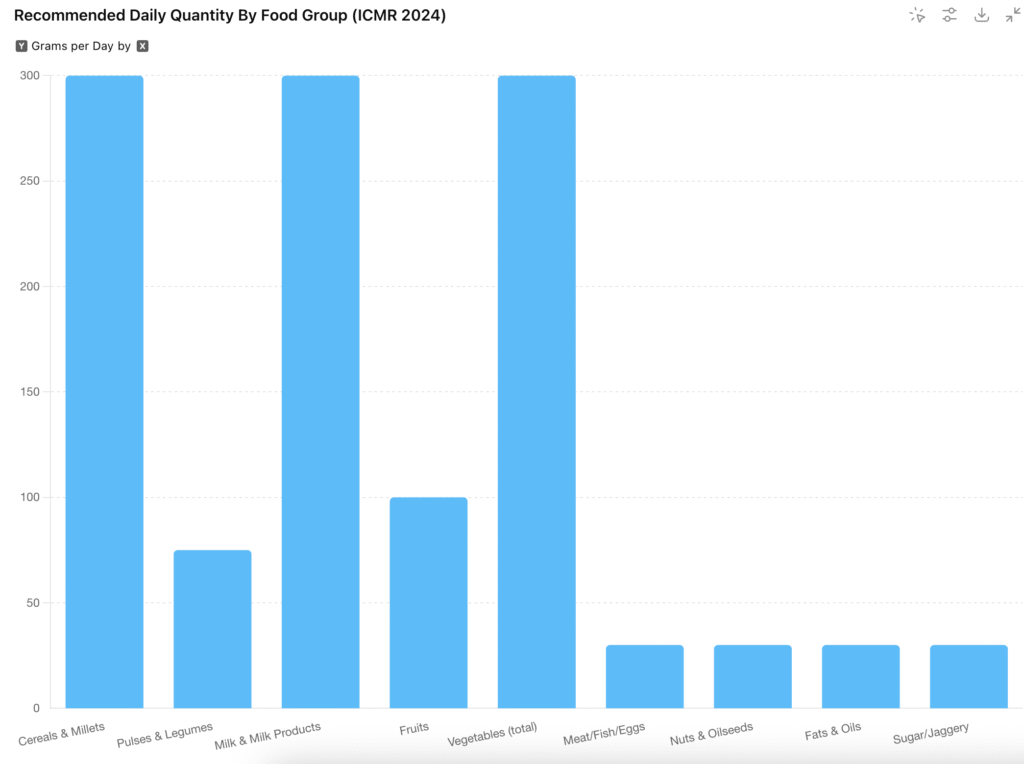
| Food Group | Recommended Grams |
|---|---|
| Cereals & Millets | 300 |
| Pulses & Legumes | 75 |
| Milk & Milk Products | 300 |
| Fruits | 100 |
| Vegetables (total) | 300 |
| Meat/Fish/Eggs | 30 |
| Nuts & Oilseeds | 30 |
| Fats & Oils | 30 |
| Sugar/Jaggery | 30 |
See the interactive table above and accompanying bar chart above for gram-level recommendations for a 2000 kcal reference diet (ICMR-NIN, 2024).
4.5 NOVA Processing Levels
Introduced by Carlos Monteiro, NOVA focuses on the extent and purpose of processing rather than nutrient numbers. Level 4 ultra-processed products (soft drinks, packaged snacks) often contain cosmetic additives, have higher glycaemic load, and are linked to excess energy intake independent of macronutrient profile.
4.6 Perishability & Storage
Knowledge of perishability guides safe storage, reduces waste and informs preservation techniques such as refrigeration, canning, drying and irradiation. Semi-perishable cereals like wheat flour require moisture-proof containers and low humidity; perishable leafy greens demand temperatures <5 °C to retard microbial spoilage.
5 · Applied Perspective
| Scenario | Classification Used | Utility |
|---|---|---|
| Designing a hospital menu | Function + Food-group | Ensures adequate protein for wound healing (body-building) & micronutrient-dense protective foods. |
| Disaster relief rationing | Perishability + Nutrient density | Emphasis on non-perishables (rice, pulses) fortified with vitamin-mineral premixes. |
| Public-health campaigns | Processing level | “Cut back on ultra-processed snacks” resonates better than listing nutrients. |
6 · Key Take-aways
- Food is more than nutrients—it embodies culture, economics and psychology.
- Multiple classification lenses—origin, chemistry, function, processing, perishability—are complementary and context-dependent.
- ICMR-NIN’s “My Plate for the Day” translates nutrient science into practical, culturally relevant food groupings.
- The NOVA system reminds us that how food is processed matters for health outcomes, not just nutrient counts.
- Understanding perishability is essential for food safety, storage economics and sustainability.
Self-Check Questions
- Explain how the same food (e.g., peanuts) can fall into different classes under separate classification systems.
- Discuss two public-health advantages of shifting staple cereals to millets in the Indian context.
- Classify the following items under NOVA and justify: a) Homemade curd b) Potato chips packet c) Raw broccoli.