Unit 1: Introduction to Human Physiology – Notes
1 · What is Physiology?
Physiology is the scientific study of how living organisms perform their vital functions. From ionic currents across a neuron’s membrane to the finely-tuned hormonal dialogue that maintains blood glucose, physiology explains how structure begets function.
- Levels of Organisation – chemical → cellular → tissue → organ → system → whole body.
- Foundational concept – milieu intérieur (internal environment) articulated by Claude Bernard and expanded into homeostasis by Walter Cannon: dynamic equilibrium via negative feedback.
2 · Body Composition & Compartments
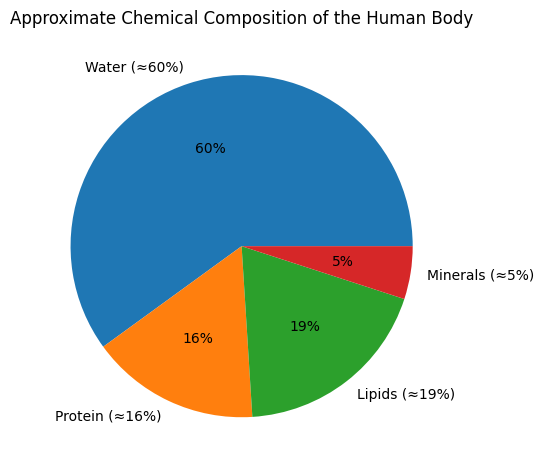
- Chemical make-up – the pie chart above shows an average adult: ~60 % water, 16 % protein, 19 % lipids, 5 % minerals. Trace elements (< 1 %) include iron, iodine, zinc, etc.
- Fluid partitioning – two-thirds intracellular, one-third extracellular (interstitial + plasma). Osmotic balance hinges on Na⁺, K⁺ and plasma proteins (oncotic pressure).
3 · Overview of Organ Systems
The table below “Major Human Organ Systems and Their Core Functions” summarises 11 systems, their key organs, and headline roles—from integumentary defence to reproductive continuity. Use it as a rapid refresher while delving into each system’s detailed physiology later in the course.
Systems interact, not isolate: e.g., muscle contraction (muscular) depends on Ca²⁺ from bone (skeletal), ATP generated by mitochondria supplied with O₂ (respiratory & cardiovascular) and regulated by motor neurones (nervous) plus thyroid hormones (endocrine).
Major Human Organ Systems and Their Core Functions
| Organ System | Primary Components | Essential Physiological Roles |
| Integumentary | Skin, hair, nails, sweat & sebaceous glands | Barrier protection, temperature regulation, vitamin D synthesis |
| Skeletal | Bones, cartilage, ligaments | Support, mineral storage, hematopoiesis, leverage |
| Muscular | Skeletal, smooth & cardiac muscles | Movement, posture, thermogenesis |
| Nervous | Brain, spinal cord, peripheral nerves | Rapid communication, coordination, cognition |
| Endocrine | Pituitary, thyroid, adrenals, pancreas, gonads | Chemical coordination, long‑range regulation, growth & metabolism |
| Cardiovascular | Heart, blood, vessels | Transport of nutrients, gases, wastes; pH & heat balance |
| Respiratory | Nasal passages, trachea, lungs | Gas exchange, acid‑base balance, vocalisation |
| Digestive | Oral cavity, esophagus, stomach, intestines, liver, pancreas | Mechanical & chemical food processing, absorption, excretion |
| Urinary | Kidneys, ureters, bladder, urethra | Waste removal, water‑electrolyte & acid‑base balance, blood pressure |
| Immune/Lymphatic | Lymph nodes, spleen, thymus, leukocytes | Defense against pathogens, fluid return, lipid transport |
| Reproductive | Testes, ovaries, associated ducts & glands | Gamete production, sex hormones, species propagation |
4 · Core Themes in Human Physiology
| Theme | Illustration | Clinical Relevance |
|---|---|---|
| Homeostasis & Feedback | Baroreceptor reflex maintains arterial pressure within seconds. | Orthostatic hypotension when reflex fails. |
| Transport Across Membranes | Na⁺/K⁺-ATPase, facilitated diffusion (GLUT-4), secondary active transport (SGLT-1). | Digoxin targets Na⁺/K⁺-pump in heart failure. |
| Signal Integration | Neural (milliseconds) vs. hormonal (seconds-hours) vs. paracrine (local). | Diabetes = deranged insulin signalling. |
| Energy Transduction | ATP generation via aerobic/anaerobic pathways. | Cyanide poisoning halts oxidative phosphorylation. |
| Plasticity & Adaptation | Muscle hypertrophy, renal concentrating ability in deserts, altitude acclimatisation. | Bed-rest atrophy; chronic kidney disease impairs adaptation. |
5 · Methods of Physiological Study
- In vivo monitoring – ECG, spirometry, blood pressure, indirect calorimetry.
- In vitro & ex vivo – perfused organ baths, patch-clamp electrophysiology.
- Imaging – fMRI maps brain activity; Doppler ultrasound tracks haemodynamics.
- -Omics – transcriptomics & metabolomics link molecular flux to systemic outputs.
6 · Physiology & Nutrition Interface
- Nutrient bioavailability affects cellular energetics, endocrine axes, and immune resilience.
- Malnutrition disrupts homeostasis: hyponatraemia in marathoners, kwashiorkor’s oedema from hypo-albuminaemia, vitamin D’s hormonal role in calcium physiology.
- Diet-induced obesity alters leptin signalling, intersecting with neuro-endocrine appetite circuits (see prior Hormonal Control topic).
7 · Key Take-aways
- Physiology deciphers function; anatomy supplies form—both inseparable.
- Homeostasis relies on layered feedback, with nervous and endocrine systems as command networks.
- All organ systems interlock; no single nutrient or hormone exerts effects in isolation.
- Quantitative tools—from ion-channel kinetics to whole-body calorimetry—enable mechanistic understanding.
- Integration of physiology with nutrition empowers preventive and therapeutic strategies.
Self-Reflection Questions
- Trace the path of a sodium ion from dietary salt to its role in generating a neuronal action potential.
- Explain how failure of negative feedback in thyroid hormone production leads to goitre.
- Describe one physiological adaptation that allows long-distance runners to maintain homeostasis during endurance events.
End of Unit 1